
Candida and Hashimoto’s: Understanding the Gut-Thyroid Connection

Many people diagnosed with Hashimoto’s thyroiditis also experience digestive symptoms such as bloating, constipation, food sensitivities, or recurrent yeast infections. It’s understandable to wonder whether these issues could be connected, especially when you come across information suggesting that Candida overgrowth may play a role.
Current evidence does not show that Candida causes Hashimoto’s thyroiditis. However, researchers are increasingly exploring how the gut microbiome, immune system, and thyroid communicate through what is known as the gut–thyroid axis. This growing area of research is helping scientists better understand how changes in the gut environment may influence immune regulation and autoimmune thyroid disease, although many questions remain unanswered.
Rather than viewing Candida as an isolated problem, it may be more helpful to think of it as one small part of a much larger gut ecosystem. The gut contains trillions of bacteria, fungi, and other microorganisms that interact with each other, the intestinal lining, and the immune system every day. Researchers are now studying how this complex relationship may affect conditions such as Hashimoto’s thyroiditis.
In this article, we’ll explore what Hashimoto’s thyroiditis is, why some people associate it with Candida, what current research says about the gut–thyroid axis, and practical ways to support your gut health as part of an overall approach to wellbeing.
Key Takeaways
- Current evidence does not support the idea that Candida causes Hashimoto’s thyroiditis.
- Researchers are increasingly studying the gut–thyroid axis to better understand how the gut microbiome, intestinal barrier, and immune system influence thyroid health.
- Candida is a normal member of the gut mycobiome and should be viewed as one part of the broader gut ecosystem.
- Supporting your gut health through a varied diet, good sleep, stress management, and appropriate medical care may benefit overall wellbeing.
- Hashimoto’s thyroiditis is a complex autoimmune disease, and there is no single known cause or cure.
What Is Hashimoto’s Thyroiditis?
Hashimoto’s thyroiditis is the most common cause of hypothyroidism in countries where iodine intake is generally adequate. It is an autoimmune condition in which the immune system mistakenly attacks the thyroid gland, leading to chronic inflammation and, over time, a gradual reduction in thyroid hormone production.
The thyroid is a small butterfly-shaped gland located at the front of the neck. Although small, it plays a vital role in regulating metabolism, energy production, body temperature, heart rate, digestion, and many other essential functions. When the thyroid doesn’t produce enough hormones, these processes can slow down, affecting almost every system in the body.
Common symptoms of Hashimoto’s thyroiditis may include:
- Persistent fatigue
- Unexplained weight gain
- Feeling cold more easily
- Constipation
- Dry skin and hair
- Brain fog or difficulty concentrating
- Depression or low mood
- Muscle weakness or joint aches
Symptoms often develop gradually and can vary considerably from one person to another. Some people experience only mild symptoms for years, while others may notice more significant changes as thyroid hormone levels decline.
Doctors typically diagnose Hashimoto’s thyroiditis using a combination of symptoms, blood tests that measure thyroid hormone levels and thyroid-stimulating hormone (TSH), and tests for thyroid antibodies, particularly thyroid peroxidase (TPO) antibodies. In some cases, an ultrasound examination of the thyroid may also be recommended.
While genetics play an important role in determining who develops Hashimoto’s thyroiditis, researchers believe that environmental factors, immune regulation, and overall gut health may also influence how autoimmune diseases develop and progress. This growing body of research has led scientists to investigate what is now known as the gut–thyroid axis—the complex communication network between the digestive system, the immune system, and the thyroid gland. Recent reviews suggest that alterations in the gut microbiome and intestinal barrier may influence immune function, although the exact mechanisms are still being investigated.
Why Do People Think Candida and Hashimoto’s Are Connected?
If you’ve spent time searching online for information about Hashimoto’s thyroiditis, you’ve probably come across articles suggesting that Candida overgrowth may be an underlying cause. It’s an appealing idea because many people with Hashimoto’s also report digestive symptoms, fatigue, brain fog, food sensitivities, or recurring yeast infections. At first glance, it can seem as though these conditions must be related.
However, it’s important to remember that sharing similar symptoms doesn’t necessarily mean two conditions have the same cause. Fatigue, digestive discomfort, constipation, and difficulty concentrating are common symptoms that can occur in many different health conditions, including hypothyroidism itself.
Researchers are now taking a broader view by looking beyond individual symptoms and focusing on the health of the gut microbiome. The gut is home to trillions of microorganisms, including bacteria, fungi, viruses, and other microbes that work together as a complex ecosystem. These microorganisms help digest food, produce important nutrients, support the intestinal barrier, and play a key role in regulating the immune system.
Candida is one of the fungi that naturally lives in this ecosystem. In healthy individuals, it usually exists in relatively small numbers alongside many other microorganisms without causing problems. Rather than viewing Candida as an isolated issue, researchers are increasingly interested in how changes to the entire gut microbiome—sometimes referred to as gut dysbiosis—may influence immune function and autoimmune diseases such as Hashimoto’s thyroiditis.
This shift in thinking is important. Instead of asking whether Candida alone causes Hashimoto’s, scientists are exploring a much broader question: Could changes in the gut ecosystem influence the immune system in ways that contribute to autoimmune thyroid disease? While research in this area is expanding rapidly, many of the answers are still emerging.
Key Takeaway
Current research does not support the idea that Candida causes Hashimoto’s thyroiditis. Instead, scientists are investigating how the gut microbiome, intestinal barrier, and immune system work together through the gut–thyroid axis. Candida is one small part of that much larger picture.
What Does Current Research Say?
Research into the relationship between gut health and autoimmune thyroid disease has expanded rapidly over the past decade. Rather than focusing solely on individual microorganisms such as Candida albicans, scientists are investigating how the entire gut microbiome influences immune function, inflammation, and thyroid health.
The gut microbiome is now recognised as an active participant in many aspects of human health. It helps regulate the immune system, supports the intestinal barrier, produces beneficial compounds such as short-chain fatty acids, and even contributes to thyroid hormone metabolism. Because Hashimoto’s thyroiditis is an autoimmune disease, researchers are exploring whether changes in the gut microbiome could influence the development or progression of the condition.
Several studies have found that people with Hashimoto’s thyroiditis often have differences in the diversity and composition of their gut microbiome compared with healthy individuals. While these findings are consistent across many studies, researchers still don’t know whether these microbial changes contribute to the disease or whether they occur as a consequence of the autoimmune process itself.
One important message emerges from the current evidence: association does not prove causation. Discovering differences in the gut microbiome doesn’t necessarily mean those changes caused Hashimoto’s thyroiditis. Autoimmune diseases are complex and are thought to result from a combination of genetic susceptibility, environmental influences, immune regulation, and lifestyle factors.
Current research also highlights the importance of the intestinal barrier, sometimes referred to as the “gut barrier.” When functioning normally, this barrier helps regulate what passes from the digestive tract into the bloodstream while keeping harmful substances contained within the gut. Scientists are investigating whether alterations in gut barrier function, together with changes in the gut microbiome, may contribute to immune dysregulation in some autoimmune diseases, including Hashimoto’s thyroiditis. While this remains an active area of research, many questions have yet to be answered.
Current Understanding at a Glance
| Research Question | What the Evidence Suggests |
|---|---|
| Does Candida cause Hashimoto’s thyroiditis? | No. There is currently no convincing evidence that Candida directly causes Hashimoto’s thyroiditis. |
| Does the gut microbiome influence immune function? | Yes. Strong evidence shows the gut microbiome plays an important role in immune regulation. |
| Is the gut microbiome different in people with Hashimoto’s? | Yes. Many studies have reported differences in microbial diversity and composition, although the significance of these changes is still being investigated. |
| Is the gut–thyroid axis a recognised area of research? | Yes. This is now one of the most active areas of thyroid research. |
| Is more research needed? | Absolutely. Scientists are still working to understand how genetics, the microbiome, immune function, and environmental factors interact in autoimmune thyroid disease. |
Research Snapshot
Current evidence suggests that the gut microbiome plays an important role in immune regulation and thyroid health. While people with Hashimoto’s thyroiditis often have changes in their gut microbiome, researchers have not shown that Candida itself causes the condition. Instead, the focus has shifted towards understanding the gut–thyroid axis and the complex interactions between the microbiome, immune system, and intestinal barrier.
Understanding the Gut–Thyroid Axis
The human body is remarkably interconnected. Although the digestive system and thyroid gland may seem unrelated, scientists now recognise that they communicate through a complex network involving the gut microbiome, the immune system, hormones, and the intestinal barrier. This relationship is known as the gut–thyroid axis. Recent reviews describe it as an important and rapidly developing area of thyroid research.
The gut microbiome consists of trillions of microorganisms, including bacteria, fungi, viruses, and other microbes that live primarily in the large intestine. Together, these microorganisms help digest food, produce vitamins and beneficial compounds, maintain the intestinal barrier, and regulate many aspects of the immune system.
The immune system is particularly important because Hashimoto’s thyroiditis is an autoimmune disease. Under normal circumstances, the immune system protects the body from harmful bacteria, viruses, and other pathogens while recognising the body’s own tissues as “self.” In autoimmune diseases, this process becomes disrupted, and the immune system mistakenly attacks healthy tissue—in the case of Hashimoto’s, the thyroid gland.
Researchers believe the gut microbiome helps educate and regulate immune cells throughout life. When the gut ecosystem becomes less diverse or its balance changes—a state often referred to as gut dysbiosis—immune signalling may also change. Scientists are actively investigating whether these changes could contribute to autoimmune diseases in genetically susceptible individuals. However, this research is ongoing, and no single microorganism has been identified as the cause of Hashimoto’s thyroiditis.
Another important part of the gut–thyroid axis is the intestinal barrier. This thin layer of specialised cells acts as a selective filter, allowing nutrients to pass into the bloodstream while helping keep potentially harmful substances inside the gut. Researchers are exploring whether changes in intestinal barrier function may influence immune activity in autoimmune diseases, although the exact relationship remains an area of active investigation.
Within this larger ecosystem, Candida represents just one member of the gut mycobiome. In healthy individuals, Candida usually exists in balance with many other microorganisms. Rather than focusing on Candida in isolation, current research is increasingly examining how bacterial communities, fungal communities, the intestinal barrier, and the immune system work together to influence overall health.
The Bigger Picture
Current research suggests the gut–thyroid axis involves far more than a single microorganism. Scientists are studying how the gut microbiome, gut mycobiome, intestinal barrier, immune system, and genetics interact to influence autoimmune thyroid diseases such as Hashimoto’s. Candida is one part of this much larger ecosystem—not the sole focus.
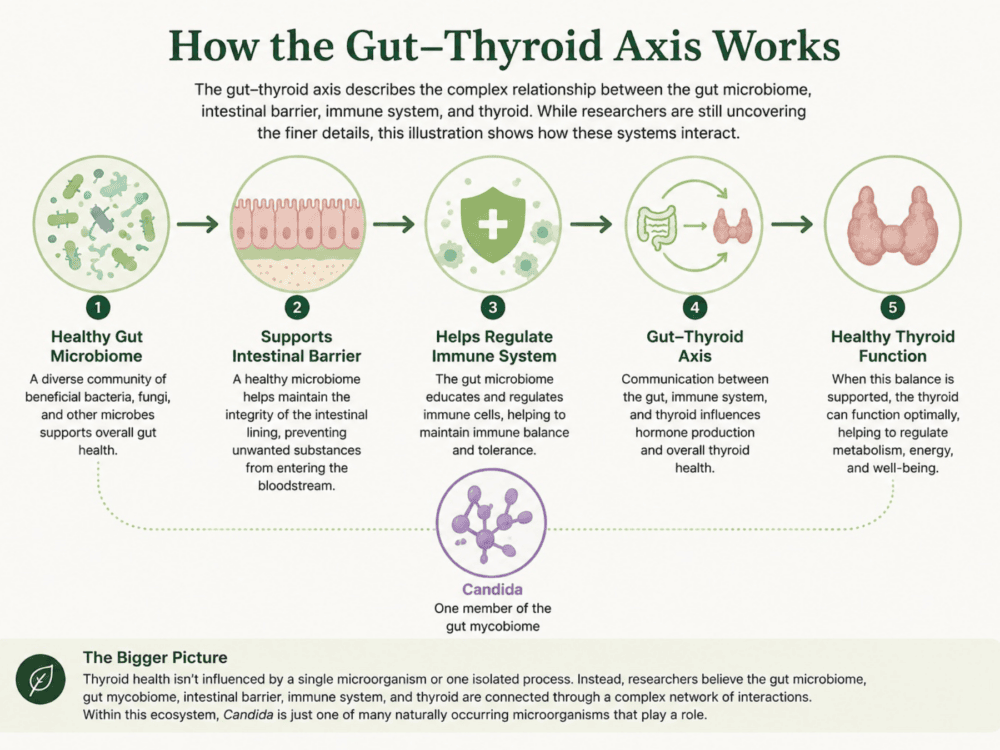
As the illustration shows, thyroid health isn’t influenced by a single microorganism or one isolated process. Instead, researchers believe the gut microbiome, intestinal barrier, immune system, and thyroid are connected through a complex network of interactions. Within this ecosystem, Candida is just one of many naturally occurring microorganisms that scientists are studying as part of the broader gut mycobiome.
Where Does Candida Fit Into the Picture?
After learning about the gut–thyroid axis, it’s natural to wonder where Candida fits into the picture.
Candida is a type of yeast that normally lives in the mouth, digestive tract, skin, and other parts of the body. Along with many other fungi, it forms part of the gut mycobiome—the fungal community that exists alongside the much larger bacterial population within the gut microbiome. In healthy individuals, Candida is usually a normal resident of the digestive tract and coexists with countless other microorganisms as part of a healthy gut ecosystem. Recent research continues to describe fungi as normal members of the intestinal microbiota, highlighting their role as part of a balanced microbial community rather than inherently harmful organisms.
If you’re unfamiliar with Candida and its normal role in the body, you may find it helpful to read our article What Is Candida Overgrowth? where we explain how this common yeast fits into the broader gut microbiome.
Although Candida receives considerable attention online, current research into Hashimoto’s thyroiditis has moved beyond searching for a single microorganism as the cause of autoimmune disease. Instead, researchers are investigating how the entire gut ecosystem—including bacteria, fungi, the intestinal barrier, microbial metabolites, and the immune system—works together to influence health. This broader perspective is now central to our understanding of the gut–thyroid axis.
This shift in thinking is important because the gut functions as a highly interconnected ecosystem. Changes affecting one group of microorganisms may influence many others, while diet, medications, infections, stress, genetics, and lifestyle all contribute to the overall balance of the microbiome. Rather than studying bacteria and fungi in isolation, scientists are increasingly exploring how these communities interact with one another and with the immune system to maintain health or contribute to disease.
At present, there is no convincing evidence that Candida directly causes Hashimoto’s thyroiditis. However, because Candida is one member of the gut mycobiome, researchers continue to investigate how fungal communities interact with bacterial communities, the intestinal barrier, and the immune system. This remains an evolving area of research, and many questions have yet to be answered before firm conclusions can be drawn.
For people living with Hashimoto’s thyroiditis, the most practical message is not to focus on eliminating one particular microorganism but to support the health of the entire gut ecosystem. Eating a varied, fibre-rich diet, managing stress, getting adequate sleep, staying physically active, and working with your healthcare provider to manage thyroid disease are all evidence-based strategies that support overall wellbeing. While researchers continue to explore the gut–thyroid axis, maintaining a healthy gut environment appears to be a more balanced and scientifically supported approach than focusing on any single microbe.
Key Takeaway
Current evidence does not identify Candida as the cause of Hashimoto’s thyroiditis. Instead, researchers are focusing on the health of the entire gut ecosystem—including the gut microbiome, gut mycobiome, intestinal barrier, and immune system—to better understand autoimmune thyroid disease. Candida is one important piece of this much larger puzzle.
Supporting Gut Health if You Have Hashimoto’s
Although researchers are still learning about the gut–thyroid axis, one message is becoming increasingly clear: supporting the health of your entire gut ecosystem is likely to be more beneficial than focusing on any single microorganism.
The gut microbiome responds to many aspects of everyday life, including diet, sleep, stress, physical activity, medications, and overall health. While no lifestyle approach has been proven to prevent or cure Hashimoto’s thyroiditis, healthy daily habits can help support digestive health, immune function, and general wellbeing. Recent reviews continue to highlight the important influence of diet and lifestyle on the gut microbiome and overall health.
Here are some practical ways to support your gut health:
Eat a varied, fibre-rich diet
A diverse diet rich in vegetables, fruits, legumes, nuts, seeds, and whole grains provides important nutrients and dietary fibre that nourish beneficial gut bacteria. Different plant foods contain different fibres and polyphenols, helping to support a more diverse and resilient gut microbiome.
Include fermented foods if they suit you
Foods such as natural yoghurt, kefir, sauerkraut, kimchi, and other traditionally fermented foods may help support microbial diversity in some people. However, not everyone tolerates fermented foods equally well, particularly those with histamine intolerance or certain digestive conditions.
If you’re wondering whether yoghurt is a good choice for gut health, you may also enjoy our article Can You Eat Yogurt on the Candida Diet?
Prioritise good sleep
Sleep and gut health are closely connected. Poor sleep may influence the gut microbiome and immune regulation, while restorative sleep supports many aspects of overall health, including immune function.
Manage stress
Chronic stress doesn’t just affect your mood—it can also influence digestion, the gut microbiome, and communication along the gut–brain axis. Finding healthy ways to manage stress, whether through walking, mindfulness, gardening, spending time in nature, or simply making time to relax, may benefit both your gut and your overall wellbeing.
Stay physically active
Regular movement supports overall health and may also have positive effects on the gut microbiome. You don’t need intense workouts—activities such as walking, swimming, cycling, or strength training can all contribute to a healthy lifestyle.
Work with your healthcare provider
Hashimoto’s thyroiditis is a medical condition that requires appropriate diagnosis and management. Supporting your gut health should be viewed as part of an overall healthy lifestyle—not as a replacement for medical care, thyroid hormone replacement when prescribed, or regular monitoring by your healthcare provider.
Supporting Your Gut Every Day
Small, consistent habits often have the greatest long-term impact.
When Should You Speak With Your Healthcare Provider?
Digestive symptoms such as bloating, constipation, diarrhoea, or food sensitivities can have many possible causes, and thyroid symptoms often overlap with other health conditions. If you’re experiencing persistent or worsening symptoms, it’s important to seek medical advice rather than trying to diagnose yourself.
You should consider speaking with your healthcare provider if you experience:
- Persistent fatigue that doesn’t improve with rest
- Unexplained weight gain or weight loss
- Ongoing constipation or significant digestive changes
- Feeling unusually cold or sensitive to cold temperatures
- Swelling or discomfort around the front of the neck
- Recurrent yeast infections or other infections that continue to return
- New or worsening symptoms despite thyroid treatment
If Hashimoto’s thyroiditis is suspected, your healthcare provider may recommend blood tests to assess thyroid function and check for thyroid antibodies. An accurate diagnosis is important because the symptoms of hypothyroidism can overlap with many other conditions, and treatment should be tailored to your individual needs.
While supporting gut health is a positive step for overall wellbeing, it should complement—not replace—appropriate medical care. Working with your healthcare provider gives you the best opportunity to manage your thyroid health while also addressing any digestive concerns that may be affecting your quality of life.
Remember
If you have persistent thyroid symptoms, digestive concerns, or recurrent yeast infections, seek advice from your healthcare provider. Supporting your gut health is an important part of overall wellbeing, but it shouldn’t replace a proper medical assessment or treatment plan.
Frequently Asked Questions
Current research does not support the idea that Candida causes Hashimoto’s thyroiditis. Scientists are increasingly studying the relationship between the gut microbiome, immune system, and thyroid health, but Hashimoto’s is considered a complex autoimmune disease influenced by genetic, environmental, and immune factors.
The gut–thyroid axis describes the complex communication between the gut microbiome, intestinal barrier, immune system, and thyroid gland. Researchers believe these systems influence one another through immune signalling, microbial metabolites, and hormone metabolism, although many aspects are still being investigated.
Yes. Candida is a naturally occurring yeast that forms part of the gut mycobiome. In healthy individuals, it usually exists alongside many other microorganisms without causing problems. If you’d like to learn more, read our article What Is Candida?
Yes. Some people with Hashimoto’s thyroiditis experience digestive symptoms such as constipation, bloating, or changes in bowel habits. These symptoms may be related to slowed metabolism associated with hypothyroidism, although other digestive conditions may also contribute.
Some studies suggest probiotics may help support gut health, but there is currently insufficient evidence to recommend probiotics specifically as a treatment for Hashimoto’s thyroiditis. If you’re considering probiotics, it’s a good idea to discuss them with your healthcare provider.
No. There is currently no evidence that treating Candida cures Hashimoto’s thyroiditis. Hashimoto’s is an autoimmune disease that requires appropriate medical diagnosis and management.
Supporting gut health through a balanced diet, adequate sleep, stress management, regular physical activity, and appropriate medical care may contribute to overall wellbeing. Researchers continue to investigate how the gut microbiome influences immune health, but this should be viewed as part of a comprehensive approach rather than a cure.
Absolutely. The gut–thyroid axis is one of the fastest-growing areas of thyroid research. Scientists continue to investigate how the gut microbiome, intestinal barrier, immune system, and thyroid interact and what this might mean for autoimmune thyroid diseases in the future.
Final Thoughts
Interest in the relationship between Candida and Hashimoto’s thyroiditis reflects a broader shift in our understanding of health. Rather than focusing on a single microorganism, researchers are increasingly exploring how the gut microbiome, gut mycobiome, intestinal barrier, and immune system work together through the gut–thyroid axis.
Although there is currently no convincing evidence that Candida causes Hashimoto’s thyroiditis, there is growing scientific interest in how the health of the gut ecosystem may influence immune regulation and autoimmune disease. As research continues to evolve, supporting your gut health through a balanced diet, healthy lifestyle habits, and appropriate medical care remains a sensible, evidence-based approach.
If you have Hashimoto’s thyroiditis or ongoing digestive concerns, remember that you’re not alone. Every person’s health journey is different, and the best outcomes usually come from combining reliable medical care with healthy lifestyle choices that support your overall wellbeing.
Continue Reading
References
American Thyroid Association. (n.d.). Hashimoto’s Thyroiditis Retrieved 2026, from American Thyroid Association – Hashimoto’s Thyroiditis.
Do N. M. (2024). From Leaky Gut to Leaky Skin: A Clinical Review of Lifestyle Influences on the Microbiome. American journal of lifestyle medicine, 15598276241292605. Advance online publication. https://doi.org/10.1177/15598276241292605
Du Toit, A. Hyphae promote Candida albicans fitness and commensalism in the gut. Nat Rev Microbiol 22, 258 (2024). https://doi.org/10.1038/s41579-024-01040-2
Ludgate, M.E., Masetti, G. & Soares, P. The relationship between the gut microbiota and thyroid disorders. Nat Rev Endocrinol 20, 511–525 (2024). https://doi.org/10.1038/s41574-024-01003-w
Ross, F. C., Patangia, D., Grimaud, G., Lavelle, A., Dempsey, E. M., Ross, R. P., & Stanton, C. (2024). The interplay between diet and the gut microbiome: implications for health and disease. Nature reviews. Microbiology, 22(11), 671–686. https://doi.org/10.1038/s41579-024-01068-4
Zhu, X., Zhang, C., Feng, S. et al. Intestinal microbiota regulates the gut-thyroid axis: the new dawn of improving Hashimoto thyroiditis. Clin Exp Med 24, 39 (2024). https://doi.org/10.1007/s10238-024-01304-4
Disclaimer: This article is intended for educational purposes only and should not be considered medical advice. Always consult your healthcare provider before making changes to your treatment plan or if you have concerns about your thyroid health or digestive symptoms.