
Spore-Based Probiotics: Benefits, How They Work & What Makes Them Different

Let’s Talk About Spore-Based Probiotics
Spore-based probiotics are a type of beneficial bacteria that survive the stomach and become active in the gut, where they can do their work. Of course, no probiotic is a cure-all, but some, like the spore-forming Bacillus coagulans in Yeastrix Active Enzymes, are designed to survive the journey through the stomach so they can become active in the intestines. This makes them different from many traditional probiotic strains, which can be more sensitive to stomach acid.
In this article, I’ll share what spore-based probiotics are, how they work, and what the science says — all in a way that’s straightforward and easy to understand.
Key Takeaways
- Spore-based probiotics, like Bacillus coagulans, survive stomach acid and support gut health effectively.
- They enter a dormant state, protecting themselves until they reach the intestines and become active bacteria.
- Research suggests that Bacillus coagulans may support digestive regularity, help reduce occasional bloating, and contribute to a balanced gut microbiome.
- Yeastrix Active Enzymes combines Bacillus coagulans with digestive enzymes for enhanced support, in a convenient capsule.
- Results vary for everyone; probiotics are just one element of overall gut health.
Estimated reading time: 7 minutes
What Are Spore-Based Probiotics?
Spore-based probiotics are spore-forming bacteria, which means they can enter a dormant state with a tough outer shell. This natural shield helps them survive stomach acid, heat, and storage so they reach your intestines alive.
Some other examples on the market include Bacillus subtilis and Bacillus clausii, each with their own unique traits.
The strain we include in Yeastrix Active Enzymes is Bacillus coagulans, because of its proven resilience and digestive support.
What Is a Spore?
A spore is like a tiny protective capsule. It keeps the bacteria safe from acid and heat. Once it reaches the intestines, it “wakes up” and becomes active, ready to interact with your gut. Once conditions are favourable in the intestines, the spore germinates—meaning it changes from its dormant state into an active bacterial cell.
How Do Spore-Based Probiotics Work?
Here’s what happens when you take a spore-based probiotic:
- Ingestion – The spores travel through your stomach intact.
- Survival – Their protective shell shields them from acid and bile.
- Activation – Once they reach the intestines, the spores germinate and become active bacteria.
- Support – They help balance your gut microbiome and may produce beneficial compounds.
Even though the research looks promising, we always remind people: everyone’s gut is different. Some people notice support quickly, others more slowly.
Research Snapshot
Unlike many traditional probiotics, spore-forming bacteria naturally produce a protective outer layer that helps them survive harsh conditions, including heat, stomach acid, and bile. Once they reach the intestines, the spores can germinate—changing from a dormant state into active bacterial cells that are able to interact with the gut microbiome.
Sources: Hill et al. (2014); Adibpour et al. (2019); Su et al. (2020).
Bacillus coagulans Benefits
No probiotic is a cure-all, and results can vary from person to person. However, research suggests that Bacillus coagulans, the spore-forming probiotic in Yeastrix Active Enzymes, may offer several digestive health benefits, including:
- Supporting digestive regularity. Some studies suggest it may help promote healthy bowel habits.
- Helping reduce occasional bloating and gas. Research indicates it may ease minor digestive discomfort in some people.
- Contributing to a balanced gut microbiome. It may help support a healthy balance of beneficial bacteria.
- Remaining stable during storage. As a spore-forming probiotic, it is naturally resilient and maintains its viability under typical storage conditions.
These findings are based on published research, but everyone’s gut microbiome is unique. Individual responses to probiotics can vary.
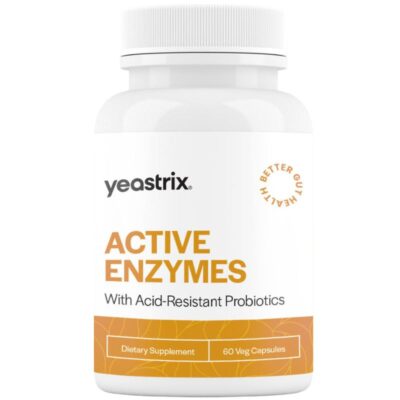
🌿 Product Spotlight: Yeastrix Active Enzymes
If you’re looking for a supplement that combines digestive enzymes with a spore-forming probiotic, here’s how we formulated ours.
Each capsule of Yeastrix Active Enzymes contains:
- 100,000,000 CFU of Bacillus coagulans (at time of manufacture)
- A blend of digestive enzymes for nutrient absorption and gut support
- A convenient once-daily formula
Eric Bakker ND designed this product so the probiotic survives the stomach, wakes up in your gut, and works alongside enzymes to support digestion — all in a simple capsule.
Spore-Based vs Traditional Probiotics: What’s the Difference?
Not all probiotics work in the same way. While spore-based probiotics are valued for their ability to survive the journey through the stomach, traditional probiotic strains each have their own strengths and roles within the gut. The table below provides a simple comparison to help explain why Yeastrix uses different probiotic formulations for different purposes.
| Type | Common strains | Primary role |
|---|---|---|
| Spore-based | Bacillus coagulans | Survive stomach acid and support digestion |
| Traditional | Lactobacillus, Bifidobacterium | Support microbial diversity and colon health |
At Yeastrix, we’ve chosen Bacillus coagulans for Active Enzymes because of its resilience as a spore-forming probiotic. Our Daily Probiotic, on the other hand, contains a blend of Lactobacillus and Bifidobacterium strains to support microbial diversity and overall gut health. Rather than trying to fit every benefit into one capsule, we’ve developed different formulations to provide more targeted digestive support.
Frequently Asked Questions
Yes. Research has found that commonly used probiotic strains of Bacillus coagulans have a favourable safety profile and have not been shown to carry clinically significant toxin genes or transferable antibiotic resistance.
Yes. They remain stable under heat, pasteurization, and acidic conditions.
Everyone’s gut is different. Some notice benefits in days, others in weeks.
Yes. Spore-based probiotics and traditional probiotics can complement each other because they work in different ways. Spore-forming strains such as Bacillus coagulans are designed to survive the journey through the stomach before becoming active in the intestines, while traditional probiotics like Lactobacillus and Bifidobacterium help support a diverse and balanced gut microbiome.
For this reason, some people choose to take both. For example, Yeastrix Active Enzymes contains Bacillus coagulans, while our Daily Probiotic provides a blend of Lactobacillus and Bifidobacterium strains. Together, they offer different forms of digestive and microbiome support.
If you’re new to probiotics or have a sensitive digestive system, it’s often a good idea to introduce one product at a time and see how your body responds. As always, if you have a medical condition or concerns about taking supplements, speak with your healthcare practitioner before starting a new regimen.
Final Thoughts
Spore-based probiotics aren’t a miracle, but they do survive the stomach and can support your gut where it counts. Bacillus coagulans, the strain in Yeastrix Active Enzymes, has been studied for its role in digestive health
Every gut is different, and probiotics are just one part of the picture. We aim to provide clear, science-backed information so you can make choices that feel right for your body.
References
Adibpour, N., Hosseininezhad, M., Pahlevanlo, A., & Hussain, M. A. (2019). A review on Bacillus coagulans as a spore-forming probiotic. Applied Food Biotechnology, 6(2), 91–100.
Hill, C., Guarner, F., Reid, G., Gibson, G. R., Merenstein, D. J., Pot, B., Morelli, L., Canani, R. B., Flint, H. J., Salminen, S., Calder, P. C., & Sanders, M. E. (2014). Expert consensus document: The International Scientific Association for Probiotics and Prebiotics consensus statement on the scope and appropriate use of the term probiotic. Nature Reviews Gastroenterology & Hepatology, 11(8), 506–514.
Mu, Y., & Cong, Y. (2019). Bacillus coagulans and its applications in medicine. Beneficial Microbes, 10(6), 679–688.
Salvetti, E., O’Toole, P. W., & others. (2023). Overview of probiotic strains of Weizmannia coagulans (previously known as Bacillus coagulans) as food supplements and their use in human health. Applied Microbiology, 3(3), 935–947.
Sanders, M. E., Merenstein, D. J., Reid, G., Gibson, G. R., & Rastall, R. A. (2019). Probiotics and prebiotics in intestinal health and disease: From biology to the clinic. Nature Reviews Gastroenterology & Hepatology, 16(10), 605–616.
Su, Y., et.al. (2020). Probiotic characteristics of Bacillus coagulans and associated implications for human health and diseases. Journal of Functional Foods, 64, Article 103643.
Continue Reading
This article is for informational purposes only and is not intended to diagnose, treat, cure, or prevent any disease. Always consult with your healthcare practitioner before starting any new supplement, dietary, or lifestyle program, especially if you have a medical condition







Leave a Reply